
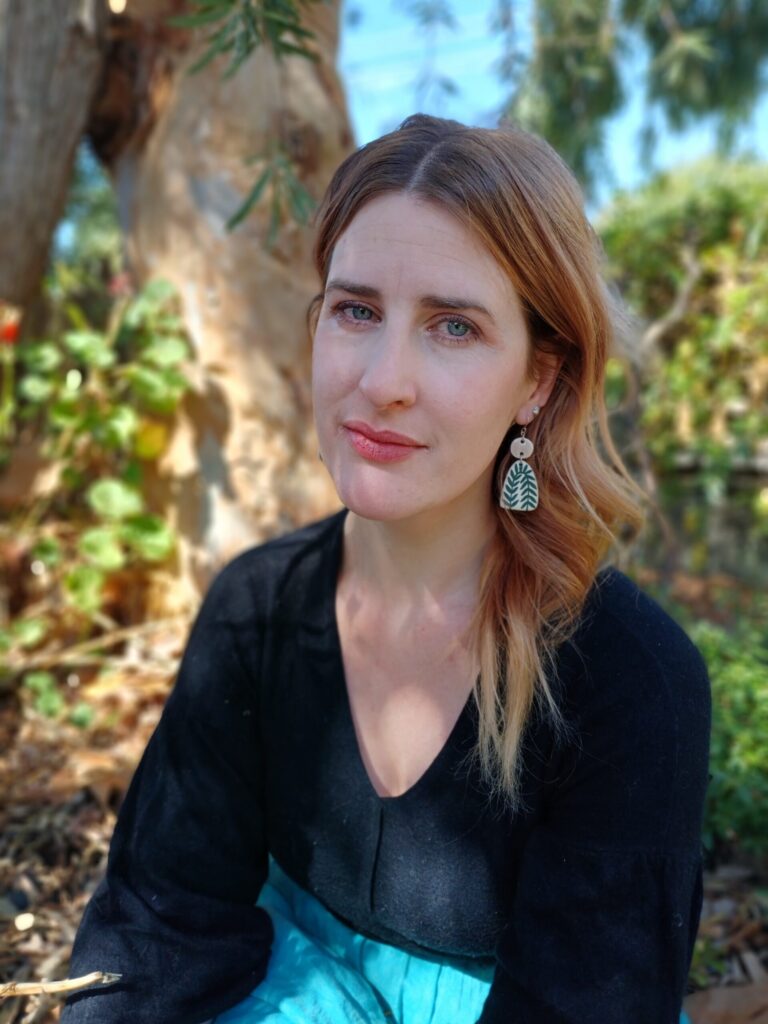
Kate Kruimink is a writer and editor from southern Lutruwita. Her first novel, A Treacherous Country, won the 2020 Vogel/Australian’s Literary Award. It was shortlisted in the Prime Minister’s Literary Award for Fiction and longlisted in the UK for the Walter Scott Prize for Historical Fiction. In 2021, she was one of the Sydney Morning Herald‘s Best Young Novelists. Kate’s second novel, Heartsease (Picador 2024), won the 2025 Tasmanian Premier’s Literary Prize for Fiction and was shortlisted in the Christina Stead Prize for Fiction in the NSW Premier’s Literary Awards. In 2024, her novella, Astraea, won the Weatherglass Books Novella Prize in the UK. Kate also writes short stories, poems and essays, which have been published widely. She is the Fiction Editor at Island.
Kate joins award-winning writer, journalist, author and novelist, Liz Evans to teach Writing a Novel (Hobart).
FWA: Kate, have you always been a writer? When did you first fall in love with the practice, and how long was it before you were ready to officially call yourself a writer?
KK: Yes, I would say I’ve been a writer for as long as I’ve known what reading and writing are. I sometimes think that in some ways, at least, writing is more of a personality trait than an inherent skill. There’s something about having the quality of being an observer, and feeling some kind of drive or responsibility to remember and record what you’ve observed, and you develop the skill in response to that.
I was shy about it for a long time, though! I had a few short pieces published here and there, but really kept it secret well enough that people were surprised when I suddenly won the Vogel in my early thirties. To them, it came out of nowhere, even though I’d been quietly writing for a long time.
I used to write fanfiction online, when I was thirteen or so. I did it a lot and always took real interest in reading others’ work, and reading people’s feedback, too. I’ve lately realised this was a lot more formative than I’d given it credit for, back in the day. And needless to say, my Tamora Pierce and Lord of the Rings fanfic was a deep, DARK secret at thirteen.
FWA: You are a celebrated author. Your debut novel, A Treacherous Country, won the Vogel Literary Award, and your second novel, Heartsease, won the 2025 Tasmanian Premier’s Literary Prize. What is the single biggest lesson you learned between writing your first and second books that you hope to pass on to your students?
KK: That as an author, you have agency and a voice, and your work is entirely unique to you. Publishing is very gatekept, and the balance of power is certainly weighted against the author, but still it is a business arrangement of mutual benefit. It’s useful to have that mindset, I think, and it doesn’t preclude feeling gratitude for the good fortune of being published, and feeling a deep respect for the people you work with.
And I’m going to cheat and choose a second single biggest lesson too, even though I’m pretty sure maths doesn’t work that way. How would I know? I’m a writer. I think the best thing you can do is write the thing you’re really interested in, bring your work to the point where it best represents your intentions, and leave it at that. You can expend a lot of energy trying to catch the zeitgeist, and I feel that’s such an unknown quantity, it’s perhaps worthier to capture the thing that feels true or exciting or relevant to you.
FWA: In addition to being an author, you are the Fiction Editor at Island magazine. How does your experience reading and editing submissions shape the advice you will give to emerging writers working on their manuscript drafts?
KK: This is such a good question. Of all my experiences in writing, I’ve learnt the most from being an Island editor, and I’ve brought a great deal of that into my teaching. My Managing Editor there once described a good editor as essentially offering a bridge between the work as it is in the writer’s head – which encompasses all its unwritten context – and the reader. At least, I think that’s how she put it. It was pretty wise. When you have to precisely articulate to a writer why you’re suggesting a certain edit, you take the perspective of the reader, who does not have access to everything in the writer’s head (which might have justified why they wrote it a certain way). But at the same time, you’re a writer yourself: hence the bridge. In that articulation and the conversation you have around it, you create this tangible element to what can otherwise seem rather intangible, or subject to a matter of taste. That’s the prime way I think my editing experience informs how I talk to students about their work: that habit of very precisely identifying what a text is doing and why, and the possibilities it creates. How it is intended, and how it might be read.
FWA: Many writers have a brilliant idea for a book but feel overwhelmed by the sheer scale of writing a full manuscript. How does the structured, phased approach of Writing a Novel help break that down into manageable, achievable steps?
KK: I’ll present it as a list, since we’re talking steps. In no particular order:
- It creates a series of smaller deadlines and goals to work towards.
- It affirms the importance of the task and provides motivation for continuing.
- It gives new input, new ideas to try, new texts to read and new inspiration, including things the writer might not have discovered on their own – even things the writer does not like, which I think is almost as valuable as things they do.
- It introduces writers to industry professionals – both through having working writers as teachers, and through guest speakers – and gives insight into an often pretty opaque field.
- It creates a writing community. Is this one the most important? I suppose it’s subjective, but for me, maybe, it is. I think this is particularly because I kept my writing under wraps for so long, and have discovered the importance of writing community relatively late. The actual act of writing is solitary, sure, but a writer implies a reader. Stories are communal, and part of their purpose is joy.
FWA: What would you say to writers who are thinking of applying? Any tips on what you will be looking for when assessing applications?
KK: I would say if you’re drawn to this course, you probably have very good reasons that are worth listening to. I would say I wish I’d done this course myself before I started publishing professionally.
I will be looking for stories that exist convincingly in their own worlds, whatever those worlds might be. I will be looking for originality and resonance and what I will now, with a sense of irony (I promise), describe with a cliché: I will be looking for a breath of fresh air.
Writing a Novel (Hobart)
with with Liz Evans, Kate Kruimink and guests
HOBART
16 February – 14 September 2027
Mondays 6pm – 8pm (AEDT/AEST)
Still deciding? Join Kate Kruimink and Liz Evans for Writing a Novel (Hobart) Taster Workshop on 28 November. Book now.