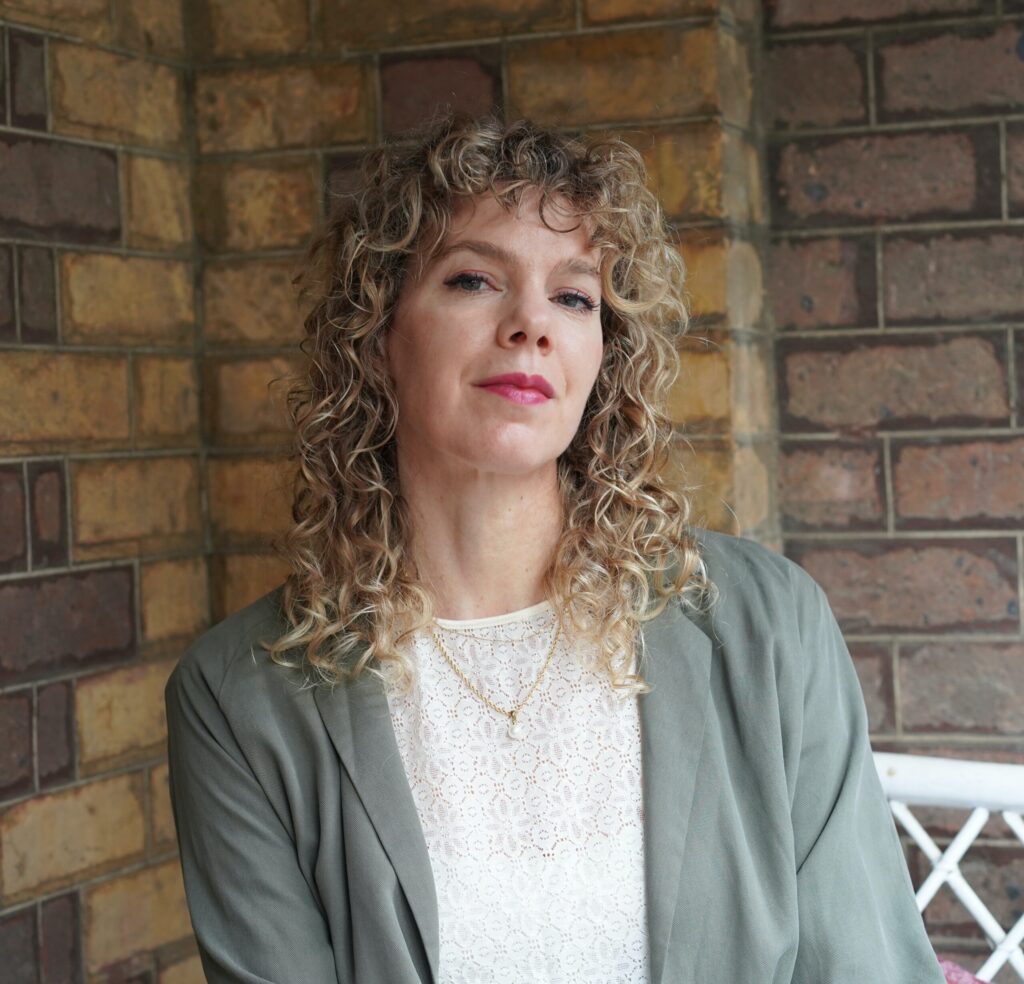
Peggy Frew is a writer and musician who lives in Narrm/Melbourne. Her work has been published in The Age, Kill Your Darlings, Meanjin, Qantas Magazine, NGV Magazine, The Griffith Review and The Big Issue. She was the winner of The Age short story competition in 2008. Her first novel, House of Sticks, won the Victorian Premier’s Literary Award for an Unpublished Manuscript by an Emerging Victorian Writer, and was shortlisted for the UTS Glenda Adams Prize for New Writing. Hope Farm, her second novel, won the Barbara Jefferis Award, was shortlisted for the Stella Prize and the Miles Franklin Literary Award, and was longlisted for the International Dublin Literary Award. Her third novel Islands, was shortlisted for the Miles Franklin Literary Award. Wildflowers is her fourth novel.
Peggy is also a musician and member of the critically acclaimed cult indie band Art of Fighting. Her solo album, Dial-Up, was released in 2024.
FWA: Peggy, as a musician and writer, how has each creative practice informed the other?
PF: I’ve moved back and forth between music and writing (mostly novels) my whole life, and they both definitely come from a similar urge, which at the most basic level is the need just to make something.
I have found the novel the ideal form for thinking through big life stuff – figuring out where I stand on a particular moral issue, for example, or understanding how a certain relationship works. Music, because it’s sounds as well as language, lends itself to perhaps a more gut-level expression of emotions . . . but then again, there are lyrics, and I do love telling a story that way! Even so, songs will always be perhaps more immediate and less nuanced than long-form prose.
FWA: You’re an award-winning writer. Has writing always come easy to you or have you wrestled with writer’s block in the past? What does your writing practice look like now?
PF: Writing did always come easy for me – until it didn’t. Covid lockdowns and various life swipes very much brought me to a writing standstill in 2022 – so yes, I have wrestled with not-writing, and it wasn’t pretty. Building my practice back up was long, slow, hard work, and it taught me a lot. My writing practice has changed as a result. I suspect it might be for the better – but in any case it is different, and I have come to realise that a person’s relationship with their creativity can have phases and continue to change. My practice now involves daily journal writing, for instance, something I never did before my dark night of the creative soul. Also I’m writing poetry now, which I think the me of five years ago would not have expected.
FWA: Writers often talk about having a love/hate relationship with writing. Staring at the blank page can feel overwhelming. How does this course help reduce the fear of failure and get people writing in flow again?
PF: Dorothy Parker said: ‘I hate writing, I love having written’, and it’s true that writing, a bit like exercise, can be hard to get started on, even when you know how good you’ll feel once you’ve done it. I don’t completely agree with DP though, because I’ve found that it really is only the getting started that’s hard, and the actual doing of writing can in fact be a real buzz. I do still have days when I have to drag myself to the page, but I have learned quite a few really reliable and practical ways to trick my brain into bypassing resistance, and I really look forward to sharing these in Cultivate Your Writing Practice.
Fear of failure does lie beneath a lot of what gets in the way of creativity, and I have found that a focus on particular markers of ‘success’, such as publication, feeds into this – hence this course’s focus on practice itself. When I think of myself at my happiest it’s not me seeing my published novel in print form (although that is a good moment!) but me riding my bike home after a really productive writing session at the library.
FWA: This course is device-free. How does a digital detox while writing help students to reconnect with their creative practice?
PF: We all know the science on this. Screen time is in many ways not a good friend of creativity, or even psychological wellbeing, and yet it’s become – in my lifetime, she says, stroking her beard – seemingly unavoidable and certainly ever-present. Who would have thought, even a few years ago, that we’d all be second-screening, and yet here we are . . .
With Cultivate Your Writing Practice, we want to do the opposite of scrolling – we want to slow down and pay attention. Did you know that even having your phone, untouched, nearby, can reduce your cognitive capacity? Our brains are at their most creative when they can concentrate for a sustained period, without distraction. Making our time together screen-free gives us the opportunity to settle into ourselves and the writing work we do with increased, unhampered focus. It’s actually a rare treat to be away from screens of some sort for two hours, and I’m excited to see where our creativity will go, given the chance.
FWA: Cultivate Your Writing Practice encourages writers to play with writing constraints. Far from shutting down our imaginations, many writers find working to limitations frees them up. You’ve just completed a thesis on the connection between constraint and creativity. How has this furthered your thinking around this idea?
PF: Creativity and constraint is my current obsession, yes! In my Masters thesis I looked into the work of Australian philosopher (and yoga teacher) Antonia Pont, whose research into creative practice has found a rich and fascinating connection between limitation and innovation.
One aspect of this is that, quite simply, our brains get overwhelmed by too many options (the dreaded blank page), but if we narrow down what we have to work with, we find innovative ways to use that. The problem-solving parts of our minds switch on, and come up with novel solutions to the ‘problems’ that the limitations create.
In my own research I experimented with writing poetry while adhering to various rules. It was playful and fun, and my poetry practice took off, and went all kinds of places – many unexpected even to myself.
FWA: This course provides an opportunity to connect with fellow writers, in-person and onsite at the brand new Allen & Unwin publishing house offices in Melbourne. How does consistently showing up every week help writers to stay on track?
PF: Cultivate Your Writing Practice is about exactly that: helping writers intentionally shape, expand, and enrich their practice of writing. The enriching and expanding parts we will do through experimenting with lots of different prompts, provocations and constraints. But we will also look into the quieter, steadier, scaffold of routine, attitude and time management that is equally crucial to a fruitful writing life – and that’s the practice part.
Antonia Pont writes that practice, which involves repetition and routine, is a ‘cultivated mode’ or sensibility, within which a window opens for creative innovation. In Cultivate Your Writing Practice I’m looking forward to helping writers establish an achievable, flexible, able-to-be-maintained routine that they will be able to continue to use to get into that state of relaxed openness that makes creativity readily accessible. Showing up every week, in person, not only connects writers with their like-minded peers, but is a great way of getting a taste (or reminder) of the rewards of a structured practice.
FWA: What sort of transformation are you hoping writers will experience by the end of this course?
PF: I’d love them to surprise themselves with the writing they do during the sessions. Creativity, I think, should be mysterious. For me, one of the most thrilling things about writing is when something appears on the page that I didn’t see coming – and I’d love to be able to help others have that experience.
I also think that a really big part of tapping into creativity is in learning to ignore or sidestep or otherwise silence your inner critic. The intentional stepping-away from outcome-focused approaches to writing that’s central to Cultivate Your Writing Practice will help with this. We really will be writing for the love of writing, first and foremost. So I’d also love to see writers tap back into the pure delight of creativity that many of us can remember from childhood (or even from pre-internet days!). I’d love to help other writers get that delight back.
Cultivate Your Writing Practice
with Peggy Frew
MELBOURNE
15 October – 3 December 2026
Thursday evenings, 6:30 – 8:30pm (AEDT)
Cultivate Your Writing Practice
with Kavita Bedford
SYDNEY
13 October – 1 December 2026
Tuesday evenings, 6:30 – 8:30pm (AEDT)