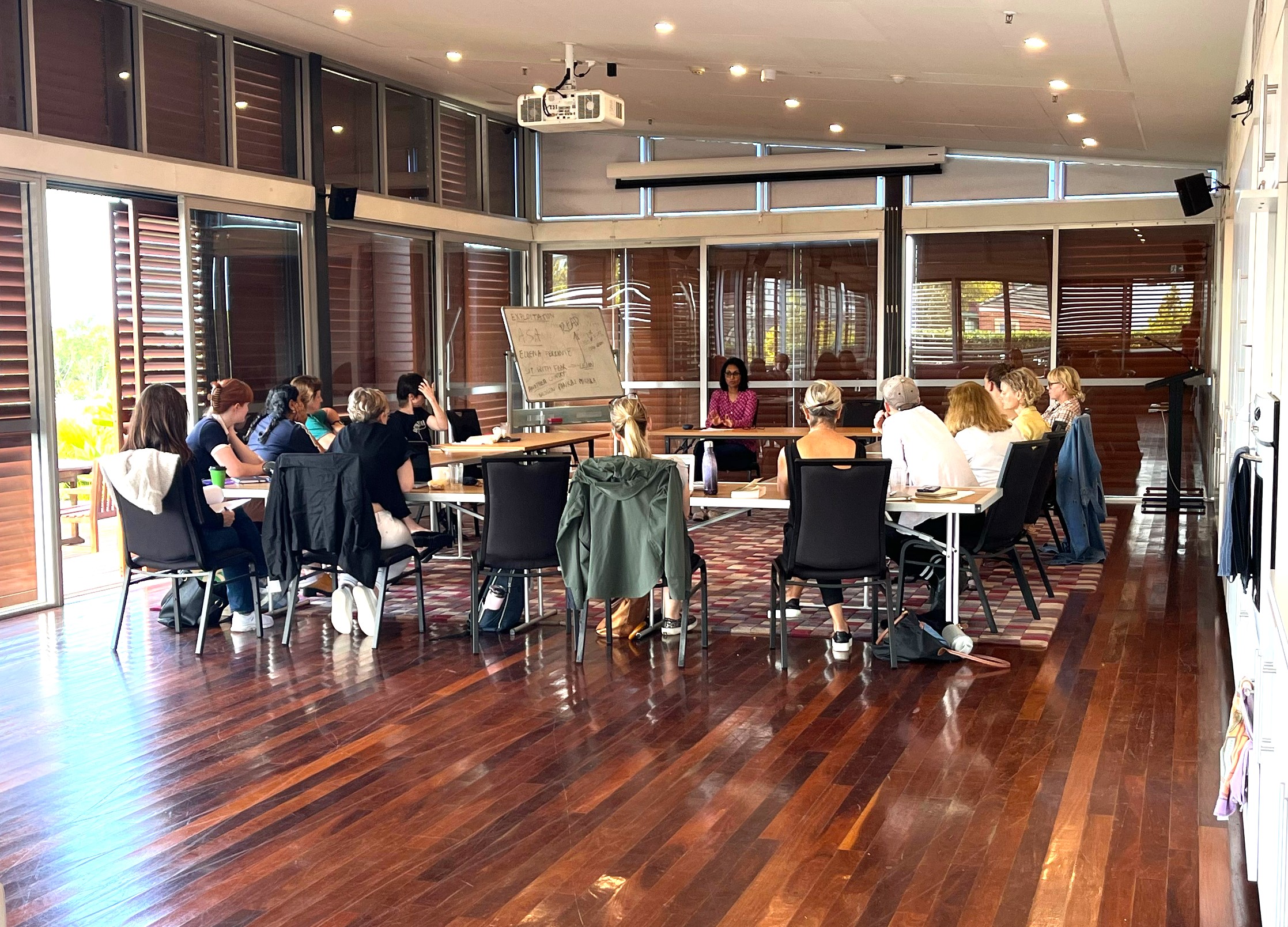
This course consists of twenty-two 2 hour evening classes, six full-day sessions and two additional evening sessions dedicated to the Faber Writing Anthology. All evening sessions, with the exception of the first and last class, will take place on Zoom on Wednesdays, 6.30pm – 8.30pm. Full-day sessions will take place in person at Kathleen Syme Library, on Saturdays from 10.00am –4.00pm.
If numbers permit, we may open up a second class held on Thursday nights, fully in person at Allen & Unwin offices. Please indicate your preference for hybrid or fully in-person classes on the application form.
Stage One: Getting Started and Fundamentals
Session 1: Wednesday, 17 February
Introductory session – held in person
Goals, obstacles, desires. Why are you writing? What matters? What are your themes? Why this story?
Session 2: Wednesday, 24 February
Reading as a writer
How to use techniques of close, targeted reading as an ongoing way of improving your craft. Setting yourself a ‘reading project’ for the year.
Session 3: Saturday, 27 February
Story, structure, plot
What are the different types of plot? Do you even need one? How do you maintain intensity and momentum with varied pacing? How do you find the right structure for your novel? While plot is related to structure the two operate independently, so consideration will also be given to the ways in which they should both support and develop the other.
Session 4: Wednesday, 3 March
Scene and summary
What is the difference between scene and summary? What is the function of each in your novel, and how do they work on the page?
Session 5: Wednesday, 10 March
Narrative point of view and tense
Who is telling the story? How and when? Will it be first, second or third person? Close or distant? Past or present tense?
Session 6: Wednesday, 17 March
Handling time
Flash-back, flash-forward and everything in between. How to handle the passage of time in your narrative on both the plot- and scene-level. Different ways to incorporate back story and to handle transitions between time periods.
Session 7: Saturday, 20 March
Characters major and minor
Who is at the heart of your novel? Who are your secondary characters and what are their roles? Inventing and observing characters. Physical and psychological description.
Session 8: Wednesday, 24 March
Place, setting, world-building
Writing place convincingly. Setting as inspiration and as character.
EASTER BREAK
Stage Two: Going Deeper into Craft
Session 9: Wednesday, 28 April
Dialogue
Listening, recording, pace, precision. Imagined truth and overheard truth. The difference between dialogue as spoken and as it reads on the page.
Session 10: Wednesday, 5 May
Showing and telling
Giving your writing power and subtlety through techniques of ‘showing’. Learning to trust your reader.
Session 11: Wednesday, 12 May
Genre and anti-genre
An industry professional will talk to us about different genres of writing and the differences (or not!) between them.
Session 12: Saturday, 15 May
Voice and psychic distance
What is meant by the term ‘voice’ in relation to the novel? What is the voice and tone of your novel? What are the possibilities and impacts of the choices you could make in relation to the level of ‘closeness’ or ‘distance’ from the inner voice/s of your character/s? How can you consciously decide on and create the tone and voice of your novel?
Session 13: Wednesday, 19 May
Fiction and the self
What are the fundamental differences between fiction and autobiography? How do we draw from our own lives to create powerful and authentic fiction? When should we recall and record, and when should we invent?
Session 14: Wednesday, 26 May
Ethical questions involved in writing
Writing fiction has freedoms, but also some responsibilities. A consideration of some ethical issues raised by drawing on real events or real people’s lives in your work. AI. Plagiarism. All the bad things.
Session 15: Wednesday, 2 June
Types of prose
The relationship between prose style, tone and voice. What type of prose style is appropriate for your novel? Thinking about the impact of sentence-level choices on your novel as a whole.
Session 16: Wednesday, 9 June
Language and detail
This session focuses on the use of detail to enrich your writing, and on figurative elements such as simile and metaphor.
WINTER BREAK
Stage Three: Big-picture thinking
Session 17: Wednesday, 21 July
Revisiting story and structure
Does enough happen in your story? What else could or should happen? What order is the best way of presenting the events of your story? How can you use structure to solve any issues that have come up thus far.
Session 18: Wednesday, 28 July
Revisiting beginnings
What are some of the common ways of beginning a novel, and what effects and expectations do they create for the reader? What are you aiming to achieve in your own opening?
Session 19: Saturday, 31 July
Structural editing
All editing requires perspective, but editing for story, plot and structure is very different to a line edit. This session has a focus on the big picture.
Session 20: Wednesday, 4 August
Theme, imagery and symbolism
What are the ‘big ideas’ at work in your novel? How are they translated onto the page via imagery and symbol?
Session 21: Wednesday, 11 August
Character and narrative arcs
How does character drive your novel? How do your protagonists ‘change’ or ‘grow’ over the course of your novel? Do they even need to? A consideration of the relationship between character, plot and structure.
Session 22: Wednesday, 18 August
Close editing
This session focuses on the process of editing your work on the sentence level, with a focus on elements such as syntax, word choice, clarity and rhythm.
Session 23: Saturday, 21 August
Guest industry professional
An industry professional will share their experience with you and answer your questions.
Session 24: Wednesday, 25 August
Secrets and tricks
Drawing on advice from a variety of writers, we will look at some final tricks to improve your writing.
SPRING BREAK & One-on-one consultations
Stage Four: Looking Outwards
Session 25: Wednesday, 6 October
Your work in the world
How do you describe your work to other people, particularly other professionals? In this session we will look at the differences between the blurb, the synopsis and the pitch, and develop ways of articulating the heart of your story.
Session 26: Saturday, 9 October
Guest agent and publisher Q&A and pitching practice
In this session we will be joined by special guests, a professional agent and a professional publisher. Students will have the opportunity to practice their pitches and ask questions about how to get an agent or publisher’s attention and how to work with them in the long term.
Session 25: Wednesday, 13 October
Endings
How do you know when you’re finished? How do you achieve satisfying resolutions? What is the deep heart of your book? In this session, we will look at endings and explore ways of tapping your originality.
Session 28: Thursday, 21 October
Getting to the end and where to next – held in person
This session will address a range of topics such as how to maintain your writing practices, submitting to literary journals, manuscript prizes, agents and publishers, as well as who to get to read your draft, the pros and cons of manuscript assessments, and options for further study in creative writing. We’ll also revisit your initial planning documents from the first week of the course. Followed by celebratory drinks.
The exact course content could be adjusted according to the experience and concerns of the group and availability of guest writers. The detail of the course is at the discretion of the Course Director and Faber Writing Academy at Allen & Unwin.
Please note, the final day of the course is on a Thursday, and will be held in person at Kathleen Syme Library.