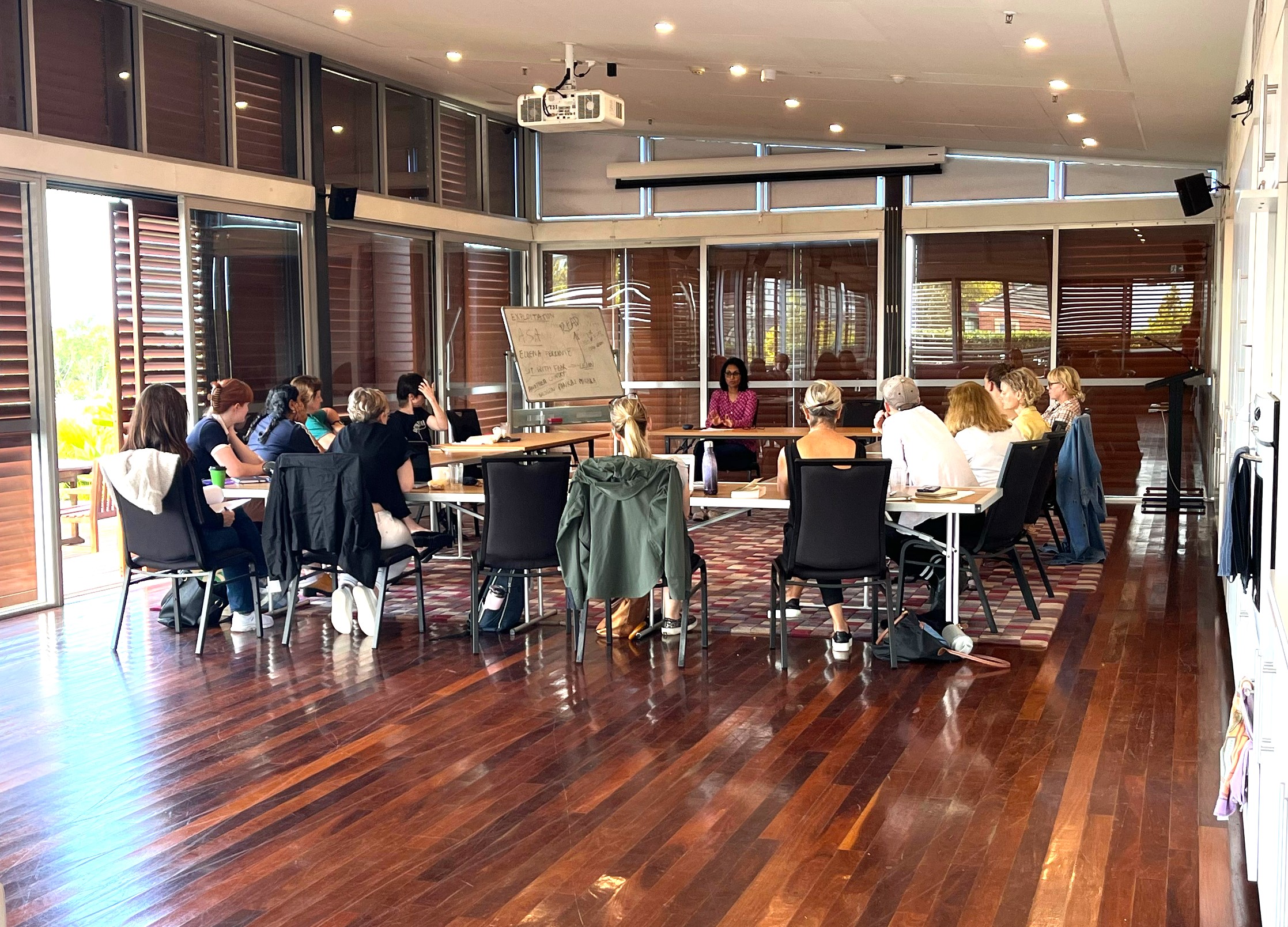
This course consists of twenty-two 2-hour Tuesday evening classes (6pm – 8pm) and six full-day Saturday sessions (9am – 3pm) held at Avid Reader Bookshop and two additional evening sessions dedicated to the Faber Writing Anthology.
Session 1: Tuesday, 16 February
Introduction
In this first session, we’ll meet our fellow writers and discuss ambitions and goals for the course. We’ll consider different approaches to process, common obstacles you might encounter when writing a manuscript and strategies to overcome them. We’ll also discuss the importance of establishing a writing practice and how to develop a sustainable writing routine that allows you to maintain momentum over the course.
Session 2: Tuesday, 23 February
Reading as a writer
Knowing how to read as a writer is an essential skill for any novelist. In this session, we’ll establish how to use close, attentive reading as a way of developing your craft, and how to successfully critique your fellow writers’ work.
Session 3: Saturday 27 February
Beginnings
What elements will you need to introduce early on in a manuscript to set up the story’s foundation? We’ll examine a range of opening chapters and their various approaches to structure, and discuss the importance of introducing compelling narrative questions to grab the reader’s attention. We’ll also discuss the importance of having a sense of an ending as you write.
Session 4: Tuesday 2 March
Showing and telling, scene and summary, and description
In this session, we’ll consider the basic elements of prose. We look at how scene and summary, and showing and telling, function within a novel, and how to approach these techniques on the page. We’ll also explore the importance of description, and how to use clear, concrete detail to make your story vivid and specific.
Session 5: Tuesday 9 March
Sentences and paragraphs
How a sentence looks and sounds is as important as what a sentence is trying to say. In this session, we examine the craft of writing on a sentence level, focusing on syntax, rhythm, and style. We’ll also explore the role of a paragraph in controlling pace and contributing to a novel’s sense of cohesion.
Session 6: Tuesday 16 March
Voice
Voice might come naturally to you as a writer, or you might need to work hard to craft a voice that is suitable for your novel. In this session, we examine how to develop a convincing and compelling narrative voice and establish your novel’s tone.
Session 7: Saturday 20 March
Point of view and tense
Who is telling the story? Will you have multiple narrative viewpoints, or a single narrator? Will it be first, second or third person? Will your narrator be reliable or unreliable? Will they tell the story in past or present tense? In this session, we unpack the benefits and limitations of each narrative perspective and discuss how to choose a point of view that best serves the needs of your story.
Session 8: Tuesday 23 March
Genre
Does your novel fit neatly into a particular genre? Does it subvert or reject genre tropes? Every story has been told before in some capacity, and in this session, we discuss how to categorise your novel, and explore how to make a recognisable narrative pattern feel fresh and original.
EASTER BREAK
Session 9: Tuesday 20 April
Dialogue
In this session, we look at the technical elements of crafting dialogue. We unpack what makes for convincing dialogue and examine how to use dialogue to progress the story and develop characterisation.
Session 10: Tuesday 27 April
Subtext
Good dialogue encompasses both what is said and what is not said, and in this session, we explore how developing subtext adds depth to how your characters communicate. We also look at developing subtext through character’s actions and behaviours.
Session 11: Tuesday 4 May
Guest author Mirandi Riwoe
This week we have the opportunity to meet award-winning author Mirandi Riwoe (Stone Sky Gold Mountain; Sunbirds; the Fish Girl) who will share insights into her process and craft.
Session 12: Saturday 8 May
Characters
The success of any novel rests on the writer’s ability to evoke the personalities and complexities of its characters. From your protagonists to your minor characters, in this session we explore how to craft memorable characters with flaws, goals, contradictions and psychological depth.
Session 13: Tuesday 11 May
Place and setting
This session will explore techniques for establishing and sustaining an evocative and immersive setting in your novel. We’ll examine the relationship between character and place, and how to transform setting from decorative backdrop to an active force that helps drive a novel and develop its themes.
Session 14: Tuesday 18 May
Guest author: Laura Elvery
This week we have the opportunity to meet award-winning author Laura Elvery (Trick of the Light; Ordinary Matter; Nightingale) who will share insights into her process and craft.
Session 15: Tuesday 25 May
Research, authenticity, and ethics
In this session, we focus on the importance of research in crafting a believable narrative and look at how to integrate research into your manuscript in a seamless and balanced way. We also consider the ethical issues raised by drawing on real events or real people’s lives in your work.
COURSE BREAK
Session 16: Tuesday 13 July
Object and detail
Writing must have the necessary quality of detail to evoke the imagined world of the story you are telling. In this session, we look at how detail and specificity add texture to your writing, and how to balance concrete and figurative imagery in your work.
Session 17: Tuesday 20 July
Theme and symbolism
In this session, we look at identifying the central themes in your manuscript, and explore how to draw out and clarify the symbols and motifs that emerge naturally in your writing.
Session 18: Tuesday 27 July
Guest author: Sally Piper
This week we have the opportunity to meet with acclaimed local author Sally Piper (Grace’s Table; The Geography of Friendship; Bone Memories), and ask her questions about her process and craft.
Session 19: Saturday 31 July
Plot and structure
Is there a more compelling way of ordering and arranging the events of your novel? How the events of a novel unfold are just as important as the events themselves. In this session, we explore a range of approaches to plot and structure.
Session 20: Tuesday 3 August
Tension, pace, and forward momentum
In this session, we explore the importance of maintaining momentum as you develop your manuscript. We’ll discuss pacing and techniques to vary and control how fast or slow your story unfolds.
Session 21: Tuesday 10 August
Handling time
In this session, we’ll look at how to handle the passing of time in your novel. We’ll examine how narrative time can be manipulated through backstory, flashbacks, and time jumps, and discuss techniques to help you seamlessly transition between time shifts.
Session 22: Tuesday 17 August
Pitch and synopsis
Articulating the plot, tone, and style of your novel requires clarity and precision. In this session, we look at the role of the pitch and synopsis, and how to craft these documents to industry standard.
Session 23: Saturday 21 August
Editing and revision
As you move closer to completing a first draft of your manuscript, in this session, we focus on the process of editing and revising your work on both a structural and line level.
Session 24: Tuesday 24 August
Endings
What makes for a satisfying ending to a novel? In this session, we explore how to wrap your story up in a way that is both surprising and plausible, and whether an ambiguous or tidy close best serves the aims of your story.
Session 25: Tuesday 31 August
Guest publisher
In this session we will be joined by a guest publisher. You’ll have the opportunity to ask questions about the publishing process, paths to publication, and practice your pitch.
Session 27: Tuesday 7 September
Guest agent
In this session, we’ll be joined by a guest agent. You’ll learn about the role an agent plays in a writer’s career and how to seek out and query an agent once your manuscript is publication-ready.
Session 26: Saturday 11 September
Voice coach and endings
Part of being a writer is knowing how to successfully communicate the style, tone, and premise of your novel. In this session, we’ll be joined by an acting and voice coach, who will lead a workshop to improve your performance and public speaking skills, equipping you with the confidence to pitch your novel and present your work to an audience.
Session 28: Tuesday 14 September
Wrap up and celebratory drinks.
Faber Writing Anthology sessions:
- Session 29: Meet the Anthology Editor
- Session 30: Meet the Faber UK Team
The exact course content could be adjusted according to the experience and concerns of the group and availability of guest writers. The detail of the course is at the discretion of the Course Director and Faber Writing Academy at Allen & Unwin.