
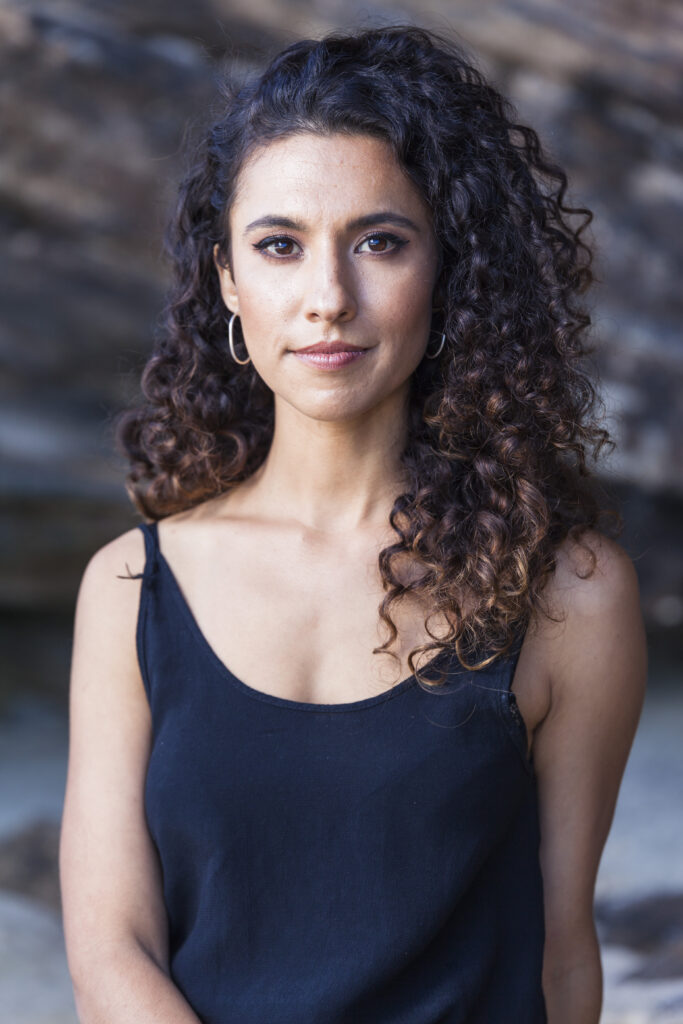
Kavita Bedford’s award-winning debut novel, Friends & Dark Shapes was published in 2021 to widespread critical acclaim, receiving praise from The New York Times, The Guardian, and Literary Hub for its lyricism, restraint, and emotional insight. Kavita will be joining Faber Writing Academy Manager, tutor and author, Pip Smith, to teach Writing a Novel (Sydney). We asked Kavita about writing with emotional nuance, how to write place with depth, and how her writing informs her teaching.
FWA: What first drew you to writing, and how did your own journey shape the way you teach emerging writers now?
K.B.: I know some writers are drawn to a particular story or plot, but for me writing began as a way to understand what I feel about something. In many ways it is still this. It is an act of pure exploration. I will have the kernel of an idea or a question but very rarely do I know how the piece will develop or what will happen. Writing is also an act of coming back to my intuition. I think this is a very important part to convey when teaching, rather than needing to know and have it all mapped out, which can give back the process of trust and curiosity to students.
FWA: Your debut novel, Friends & Dark Shapes, engages deeply with Sydney and its social and emotional complexities—how do you approach writing place in a way that feels alive and integral to the story rather than just a backdrop?
K.B.: I find there is a strong symbiotic relationship between self and place, and the flaneur relationship is one that intrigues me and one I enjoy reading. In the book the narrator walks and boards trains that crisscross the city, taking her from one suburb to the next. In some, she talks to the locals in different suburbs about their stories; a young hijab fashion designer setting up her own shop, a shoe repairer from Lebanon who recounts the changing demographics of his area. And other suburbs were used to evoke memories of the narrator’s own past, like her relationship with her father and her messy teenage years. A lot of this was drawn from real interviews that I conducted and so I was able to use the cadence of speech and use others’ stories to help inscribe the memory of place. I also take notes of signs and interactions I observe in different locations and I was able to weave those throughout.
FWA: Your work often explores interiority and emotional nuance—how do you help students learn to trust subtlety rather than over-explaining on the page?
K.B.: This is such a difficult and important part! I always go through my own writing and if there’s anything that I feel is polemical or tells the reader what to think, I try to cut it. It can be crushing to the self-ego as you often want to say, look at me, I know this! I also continually have to undo my journalistic and academic training which sneaks in. But I really believe in the power of the unsaid and restraint and it’s something I encourage my students to explore.
FWA: When you’re starting a new work, what tends to come first for you: voice, character, or structure—and how do you guide students who feel overwhelmed at the beginning?
K.B.: Voice is the heart beat of the writing for me and once I have it, I know I’m on the home stretch. But having said that, I often have to write many drafts before it becomes clear.
I think overwhelm is part of the process. There is no magic pill to stop all these feelings of vulnerability while we write. So, I think a lot of the guidance comes from learning to accept this. And learning which parts to listen and trust and which parts are the sabotaging critic.
FWA: What’s a common misconception new novelists have about the drafting process that you’re excited to challenge in this course?
K.B.: There can be a misconception about the amount of time that it takes. The drafting process takes longer than you expect. But it is through the act of editing and refining and re-writing you become a better writer.
FWA: What do you hope students walk away with at the end of the course—beyond a manuscript or a set of pages?
K.B.: Learning to trust in your own intuition and creative impulse. That’s the real lesson that you can carry for life.
Writing a Novel (Sydney)
with Kavita Bedford and Pip Smith
SYDNEY
February – September 2026
Monday OR Tuesday evenings + 6 full-day Saturday sessions
6:30pm – 8:30pm (AEDT/AEST)