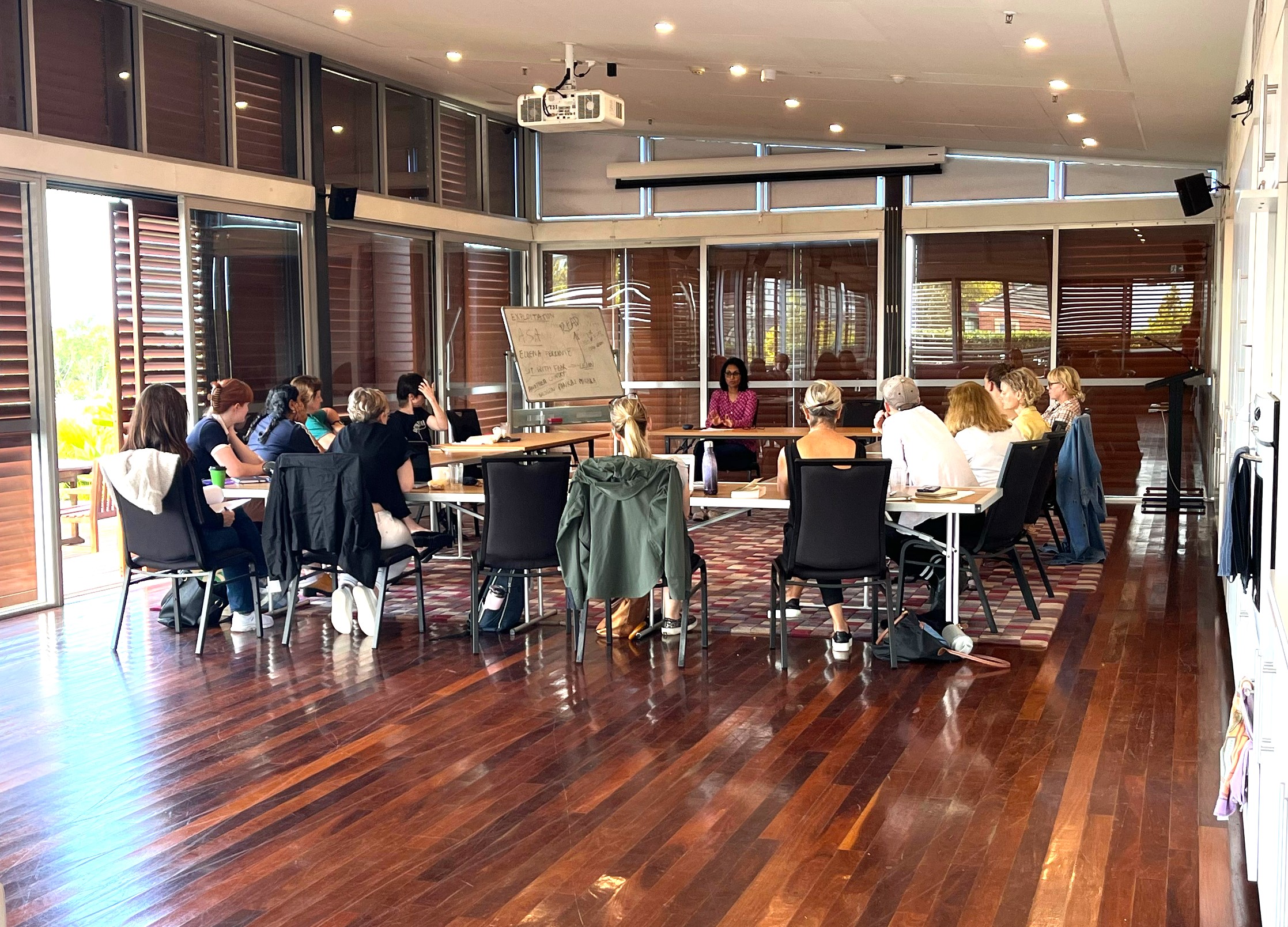
This course consists of 32 x Thursday evening sessions, 6.30 pm – 8.30 pm AEST/AEDT. An additional evening session dedicated to the Faber Writing Anthology will be run in 2027.
Stage One: Getting started and foundations
Session 1: Thursday, 23 July
Introductions and Inspiration
Why are we here? Where would we like to be at the end of the course? What do we love about writing? Get to know your tutor and fellow classmates, discover what inspires you, and start making concrete goals for your writing practice.
Session 2: Thursday, 30 July
Beginnings
How do novels start? We will look at some unforgettable first pages to get inspiration. How do you get started writing a novel, or restart if you lose your way? We will do some generative writing exercises for exploration.
Session 3: Thursday, 6 August
Genres
What kind of book are you writing? Why does it matter? Genres tell readers what to expect from a story, and work as a guide to where your book will sit on the shelf in a bookstore. But they are not rules that are set in stone. We discuss how to work with genre creatively as a space of possibility. The second hour of this class sees the first of our peer/instructor workshops. A maximum of two students will submit 2000 words from their work-in-progress for constructive feedback from the group. Your instructor will guide the discussion.
Session 4: Thursday, 13 August
Conflict
The essential ingredient of plot and character. The word “conflict” might initially sound very dramatic, as though every story must include an explosive argument or a duel at dawn. But conflict can be very subtle and encompass a range of tensions that drive a story forward. We look at how to use conflict to bring dynamic energy to plot and character. The second hour of this class sees the second of our peer/instructor workshops.
Session 5: Thursday 20 August
Character
What are some of the hallmarks of successfully realised characters? We all want to craft convincing, memorable characters that come to life on the page. We don’t want them to be predictable – but we want them to be believable, intriguing, compelling and unique. We explore how to create convincing characters and bring them to life. The second hour of this class sees the third of our peer/instructor workshops.
Session 6: Thursday, 27 August
Narrative Voice and Point of View
Who is telling your story? This is one of the first choices you make as a writer. We will discuss what a difference it can make to tell your story from first, second or third person, and look in depth at how writers use those voices to dramatically different effects. Point of view is related to but distinct from narrative voice. It can be subtle, but mastering point of view is an essential ingredient to grounding the reader in the world of your story. The second hour of this class sees the fourth of our peer/instructor workshops.
Session 7: Thursday, 3 September
Guest Author
Your chance to ask a published author questions about their writing practice and publishing journey. The second hour of this class sees the fifth of our peer/instructor workshops.
Session 8: Thursday, 10 September
Plot
What is plot, exactly? Distinct from the story itself, plot relates to how your story is arranged. We discuss essential ingredients for effective and engaging plots, how to generate tension within a story by carefully shaping plot and pacing, and the role of subplots in enriching your novel. The second hour of this class sees the sixth and final peer/instructor workshop for stage one.
COURSE BREAK [one-on-one consultations with Kirsten]
Stage Two: Going deeper into process, practice and craft
Session 9: Thursday 22 October
Research
What happens when we need to learn more about actual stuff we don’t already know — a period in time or a particular place we have never been, or a musical instrument our character wants to play? What does research for fiction look like? How is it different from other research and how does it feature in your actual writing?
Session 10: Thursday, 29 October
Dialogue
What does dialogue do for your story and characters? How can we write dialogue that feels true? Dialogue is so much more than just words: we look in depth at the role of silence, gesture, and thought in crafting dialogue that moves your story forward and builds character.
Session 11: Thursday, 5 November
Guest Author
Your chance to ask a published author questions about their writing practice and publishing journey. The second hour of this class sees the first of our peer/instructor workshops for stage two. A maximum of two students will submit 2000 words from their work-in-progress for constructive feedback from the group. Your instructor will guide the discussion.
Session 12: Thursday, 12 November
Setting
World-building is a crucial part of fantasy and SF, but all fiction needs to create a convincing fictional world. We discuss techniques for how to create convincing worlds, whatever the genre. The second hour of this class sees the second of our peer/instructor workshops for stage two.
Session 13: Thursday, 19 November
Working with Uncertainty
Sometimes we are told to write from what we know. But what if we take a more questioning approach, and lean into what we don’t know? We discuss the importance of learning to trust your reader, and how to allow your writing to render problems instead of solving them. The second hour of this class sees the third of our peer/instructor workshops for stage two.
Session 14: Thursday, 26 November
Handling Time
We explore ideas about to manage the passage of time, handle flashbacks and ground your reader in the time of your story. The second hour of this class sees the fourth of our peer/instructor workshops for stage two.
Session 15: Thursday, 3 December
Sensory Imagery
Learn how to bring sight, sound, and all kinds of sensation into your descriptions to create moments of rich emotion. We take a deep dive into creating the details that bring your writing alive, speaking to all the senses. The second hour of this class sees the fifth of our peer/instructor workshops for stage two.
Session 16: Thursday, 10 December
Symbolism and Motifs
How can symbolism and motifs enrich your story? What symbols and motifs are already at work in our writing that we can bring to the surface? We reflect on how symbolism works, and how to avoid being too heavy-handed with meaningfulness in our approach. The second hour of this class sees the sixth and final peer/instructor workshop for stage two.
COURSE BREAK
Stage Three: Editing and revision
Session 17: Thursday, 4 February
Process & Practice
A chance to reconnect with the aspects of our practice that are serving us well, and to reflect on goals so far, this class will include time for writing and setting realistic, achievable goals.
Session 18: Thursday, 11 February
“Show, Don’t Tell”
What does this mean? Aren’t we in the business of telling stories? We discuss how to make space for your reader and avoid over-explaining, and how to “tell” your reader what they need to know in a way that opens up imaginative possibilities.
Session 19: Thursday, 18 February
Art and Life
Writers are observers. We take notes; we give ourselves permission to mine life for gold to turn into fiction. How do we do this responsibly? In this class we explore the complex ethics of writing fiction drawn from life. The second hour of this class sees the first of our peer/instructor workshops for stage three. A maximum of two students will submit 2000 words from their work-in-progress for constructive feedback from the group. Your instructor will guide the discussion.
Session 20: Thursday, 25 February
Editing
How do we edit our own work? How are we making use of workshop feedback so far? We will look closely at two versions of a story by the great Raymond Carver to think about the power of editing in the creative process. The second hour of this class sees the second of our peer/instructor workshops for stage three.
Session 21: Thursday, 4 March
Guest Editor
Meet a practising editor who will walk you through the editing process, and share their tips on how to be an author that editors love to work with! The second hour of this class sees the third of our peer/instructor workshops for stage three.
Session 22: Thursday, 11 March
The Sentence
We break down and demystify how writing works at the level of sentence. In this class we will learn the art of passive and active voice, and debate the virtues of the semicolon. This is your chance to learn grammar terms you didn’t know you needed, and to use the rhythm of prose to great effect in your own writing. The second hour of this class sees the fourth of our peer/instructor workshops for stage three.
Session 23: Thursday, 18 March
Outlining
We discuss how to use this fantastic tool in drafting and revising your novel. When your manuscript starts to feel messy or unwieldy, outlining can help you see what is really going on in your story and where you need to go next. Whether you use a whiteboard, pen and paper, or a Google Doc, outlining is a great way to get a handle on how your plots are taking shape. The second hour of this class sees the fifth of our peer/instructor workshops for stage three.
Session 24: Thursday, 25 March
Structural Editing
What kinds of questions guide structural editing as opposed to other kinds of editing, and how do you handle making big changes to a messy document like a novel? In this class, we look at some real-life examples of structural edits done by your tutor and think about how you can apply some strategies of structural editing to your own revision practice. The second hour of this class sees the sixth and final of our peer/instructor workshops for stage three.
COURSE BREAK
[one-on-one consultations with Kirsten Tranter]
Stage Four: Revising, Polishing, and looking outwards
Session 25: Thursday, 29 April
Beginnings and Endings
How does your novel start? Often the first pages of a novel are not the first pages we write when we start a draft. How does your novel end? We discuss what makes a satisfying conclusion to a story.
Session 26: Thursday, 6 May
The Big Picture: Hooks, themes and what actually happens in your novel
In this session we encourage you to make sense of the wood, and not the trees. Do you have a compelling hook at the heart of your novel? What is the nub? What is the central theme? Can you summarise what actually happens in your story in a simple sentence? Is this the novel you set out to write, or has it become something else? Knowing these things will make your life easier when it comes time to pitch your novel.
Session 27: Thursday, 13 May
Blurb, Synopsis, Pitch
How do you pitch your work in the most effective way to professionals in publishing? In this class we will work on a pitch for your novel, practice it, and learn how to write a compelling synopsis.
Session 28: Thursday, 20 May
Guest Literary Agent
This session, we will meet a literary agent who will speak to you about the publishing industry and their role in it, and their relationships with their clients. The second hour of this class sees the first of our peer/instructor workshops for stage four. A maximum of three students will submit a 1000 word pitch and/ or synopsis for constructive feedback from the group. Your instructor will guide the discussion.
Session 29: Thursday, 27 May
Articulating Your Project
In this session, you will meet a skilled presenter who will teach you performance skills for festival appearances, readings and pitching. We will also discuss approaches to being interviewed, as well as how to contribute meaningfully to panel discussions in public settings. The second hour of this class sees the second of our peer/instructor workshops for stage four.
Session 30: Thursday, 3 June
Guest Publisher
At this session, we will be joined by a guest publisher. Having refined and practised your pitches, each student will formally present theirs to the publisher, who will then offer constructive feedback. You may also take this opportunity to ask other questions of the publisher. The second hour of this class sees the third of our peer/instructor workshops for stage four.
Session 31: Thursday, 10 June
Promoting Your Work
How do you organise a book tour? What promotion is expected of an author, a publicist and a publisher in 2027? How do you plan a career beyond the first book? We’ll tackle these questions and more at our penultimate class. The second hour of this class sees the fourth and final peer/instructor workshops for stage four.
Session 32: Thursday, 17 June
Celebration and Final Readings! We will hear extracts from your novels, and discuss the distances you have travelled in your work, as well as discuss ways of maintaining your writing practice and remaining part of a supportive group of fellow writers. We take a look at opportunities for submitting your work to prizes, grants, residencies, publishers and agents.
All sessions are held online on Zoom. The exact course content could be adjusted according to the experience and concerns of the group and availability of guest writers. The detail of the course is at the discretion of the Course Director and Faber Writing Academy at Allen & Unwin.